

The Space Between Data and Intuition
Oz never did give nothing to the Tin Man that he didn't, didn't already have. – America, Tinman

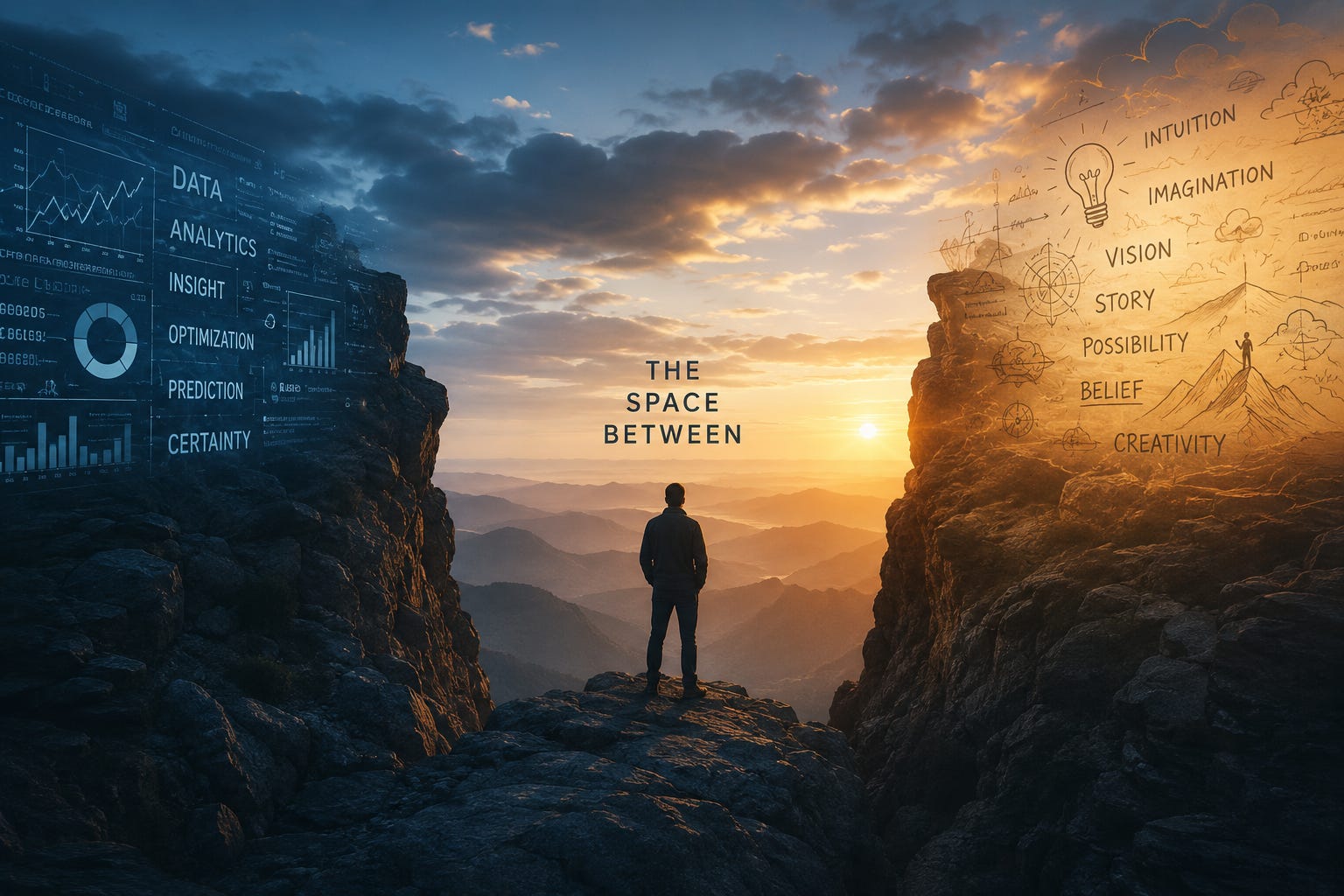
In doing research for my book, I recently stumbled across a fascinating article in Popular Mechanics asking a question that sounds more like science fiction than science: What if some of our strongest gut feelings are actually memories from the future? The article explores the work of neuroscientists, physicists, and consciousness researchers studying precognition, nonlinear time, and the possibility that our minds may occasionally know something before our conscious awareness catches up. Whether any of those theories ultimately prove true is almost beside the point.
What captivated me wasn’t the possibility that consciousness might travel through time. It was the much quieter question hiding beneath it…
Where does knowing come from?
Ever since a psychic changed my life and gave me a new belief, I’ve spent most of my career surrounded by people who are paid to know. Founders. CEOs. Brand strategists. Entrepreneurs. Professional athletes. Designers. Coaches. The interesting ones rarely make decisions by spreadsheet alone. They certainly pay attention to the numbers, but somewhere in the process another voice resonates more. Sometimes it arrives as a feeling. Sometimes as a pattern no one else seems to notice. Sometimes as an idea that refuses to go away, even when others want it gone.
Every meaningful thing I’ve ever built has begun that way.
Long before there was a Belgian Waffle Ride, there was simply a feeling that cyclists wanted something the industry wasn’t giving them. Every conversation I had suggested otherwise. The prevailing wisdom said road riders wanted smoother roads, predictable courses, aid stations every twenty miles, and a medal waiting at the finish. Nothing in the available data suggested they wanted to ride through creek crossings, hike-a-bike sections, sand pits, and miles of rocky singletrack before celebrating with waffles and beer.
The data would almost certainly have advised against it.
Fortunately, businesses aren’t built by data alone.
I know some newer or less enlightened marketers will read that sentence and find it strange coming from someone who believes deeply in research, testing, analytics, and measurement. I like data., but I love intuition. All these decades, I have been spent making marketing decisions informed by retailer commentary, customer behavior, demographics, digital analytics, and every measurable signal available. Data has made all of us better marketers.
It has also quietly tempted us to confuse information with imagination.
Artificial intelligence represents the logical extension of that temptation. Feed it enough information and it becomes astonishingly good at identifying patterns, predicting behavior, optimizing headlines, segmenting audiences, and recommending the next best action. For the brands I work with, I use these tools nearly every day, and I suspect anyone who ignores them will soon find themselves competing without the benefit of carbon enhanced super shoes.
Still, many don’t see there is a difference between recognizing patterns and creating them.
Every AI model is trained on what has already happened. It learns from billions of examples of yesterday. It can tell us which headline is most likely to generate another click because somewhere in its enormous memory, similar headlines have succeeded before.
That is some pretty interesting capability, but we shouldn’t mistake it as imagination.
The most memorable brands have always emerged from places where the evidence was incomplete. Steve Jobs didn’t ask consumers whether they wanted an iPhone. Patagonia wasn’t built by focus groups looking for another outdoor apparel company. Nike didn’t become Nike because a dashboard recommended three simple words that happened to become Just Do It.
The same is always true of the best: someone sensed a truth before they could prove it.
My research has confirmed what I already knew; what we casually call intuition is often nothing mystical at all. It is accumulated experience quietly doing its work beneath conscious awareness. Every failure you’ve survived. Every conversation you’ve had. Every book you’ve read. Every product launch that exceeded expectations. Every campaign that collapsed despite everyone’s confidence. The brain is constantly collecting fragments long before it assembles them into something we recognize as insight.
Neuroscientists have been telling us for years that perception itself works this way. The brain isn’t simply observing reality. It is continuously predicting it, comparing expectations with incoming information, and revising its internal model of the world. We experience the finished conclusion without witnessing most of the remarkable work that produced it.
Perhaps that is why experienced leaders sometimes know before they know why.
Whether consciousness can literally remember the future is a fascinating scientific question, but it isn’t the one that keeps me thinking. The question that intrigues me is what happens when organizations lose the ability to trust experienced human judgment because every important decision must first survive the approval of an algorithm.
Optimization is seductive because it feels objective. Originality rarely does. Original ideas almost always look unreasonable before they look inevitable.
The challenge facing business over the next decade won’t be deciding between artificial intelligence and human creativity. The companies that flourish will almost certainly embrace both. The challenge will be understanding where each belongs. Data should sharpen our thinking, expose our blind spots, and challenge our assumptions. It should make intuition smarter. What it cannot do is replace the leap that every genuinely original idea eventually requires.
That leap lives somewhere else.
I’ve only spent the past year writing The Space Between, but in many ways I’ve been collecting it for decades. Again and again I found myself drawn to people who acted before certainty arrived. Athletes who committed before they knew they could finish. Artists who began before they knew anyone would care. Entrepreneurs who left secure careers armed with little more than a conviction they couldn’t yet explain. None of them ignored evidence. They simply understood that evidence and belief arrive in a particular order.
Belief almost always comes first.
Perhaps that is the real lesson buried inside all the speculation about consciousness and time. Whether our minds can glimpse the future remains an open question. What seems much less controversial is that every meaningful future begins as something that cannot yet be measured.
The spreadsheet eventually catches up.
The imagination has to arrive first.
Beautiful insight … a lot of truth Michael… thank you …