
The Kook Cord and the Algorithm
What Surfing Taught Me About AI, Creativity, and the Value of Friction

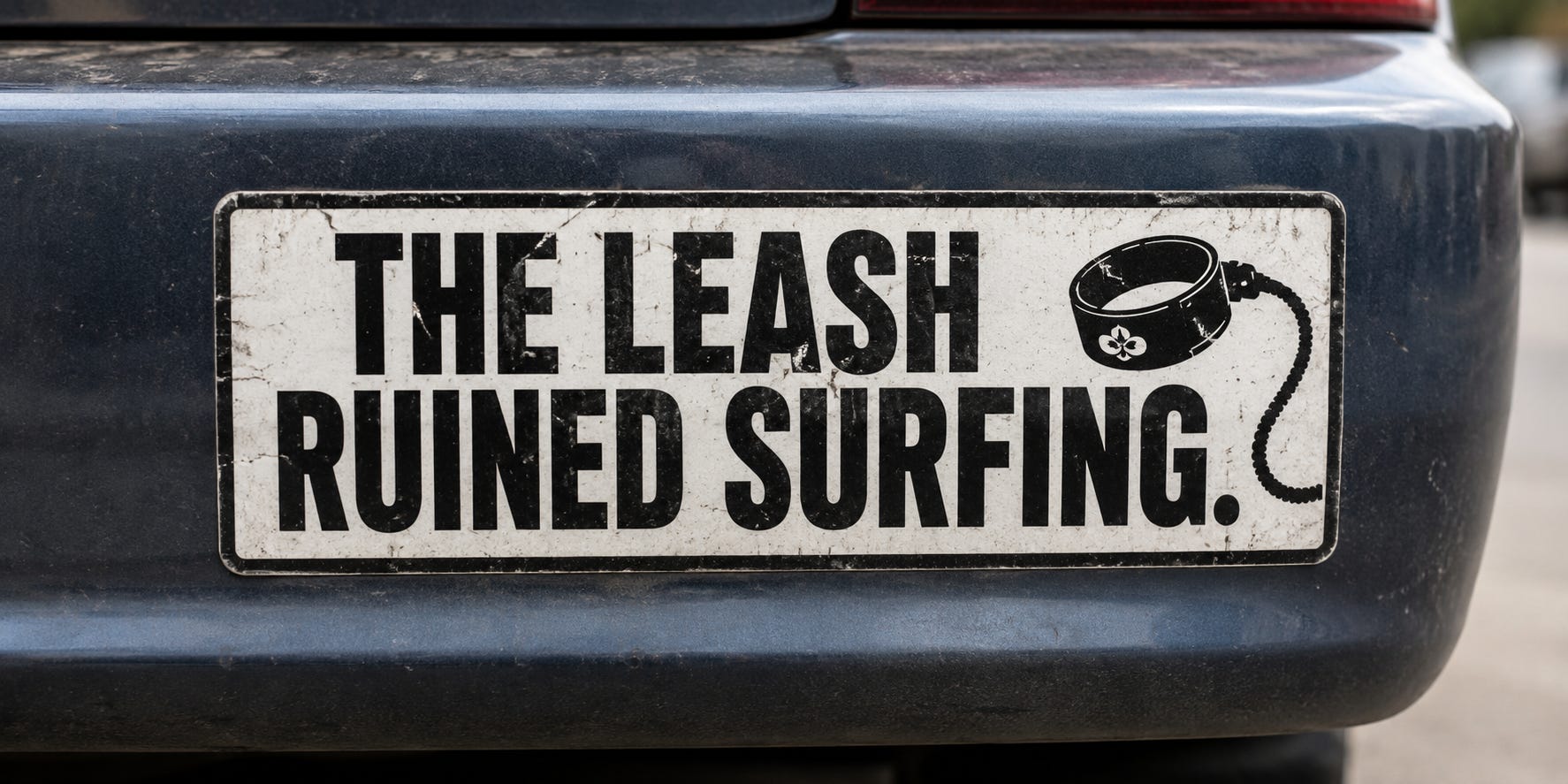
Some say the leash ruined surfing.
I don’t think that’s completely right, but I do think it changed surfing in ways we’re only beginning to appreciate.
I can already hear the objections. Leashes made surfing safer. They kept boards from washing into rocks, prevented countless injuries, and made it possible for beginners to spend more time riding waves than swimming after them. They also reduced the consequences of making mistakes. Blow a takeoff, ditch your board, and thirty seconds later you’re paddling back into the lineup with little more than a bruised ego.
That’s what has always fascinated me about technology. Every meaningful innovation solves a problem, but in doing so it invariably changes something else. Sometimes the tradeoff is obvious. More often, it’s so subtle we barely notice it until years later, when we realize we’ve exchanged one capability for another. We no longer memorize phone numbers because our smartphones do it for us. We navigate by GPS instead of developing an internal map. We gain convenience, but we quietly surrender skills we once considered essential. Technology rarely takes something from us outright. It simply gives us less reason to develop it in the first place.
I believe that’s exactly what happened to surfing, and I can’t help wondering if we’re watching it happen again through artificial intelligence.
I caught my first real wave when I was ten years old. It wasn’t whitewater or a straight ride toward the beach. I angled across the face, felt the board come alive beneath my feet, and experienced something that quietly changed the trajectory of my life. More than fifty years later, I can still retrieve that memory with remarkable clarity. It’s one of those mental Polaroids that has never faded.
That wave changed the way I looked at skateboarding without my realizing it. Tricks, ramps, and bowls gradually gave way to carving. I wasn’t trying to imitate skateboarders anymore. I was trying to recreate the feeling of surfing on concrete because surfing had quietly become my obsession.
Growing up in Palos Verdes during the 1970s, surfing wasn’t simply a sport. It was an education, and like every good education, it came with tuition.
One of the first lessons was that you didn’t wear a leash.
If someone paddled out wearing what we called a “kook cord,” it usually meant they were new. The leash wasn’t just another piece of equipment. It represented a different relationship with the ocean, one where most of the accountability had been removed.
Without a leash, you learned quickly. You learned not to fall, or more accurately, you learned how to fall. If you wiped out, you grabbed your board before the whitewater did. If you couldn’t, you swam. Sometimes it was a long swim. Sometimes your board bounced across the reef and came back looking like it had lost a fight.
That wasn’t bad luck. It was part of becoming a surfer.
Every mistake carried a consequence, and every consequence taught you something. You learned to read the ocean before paddling for a wave you couldn’t make. You learned to control your board because letting it go endangered everyone around you. You learned patience, etiquette, humility, and responsibility because the ocean had a remarkable way of collecting payment from those who ignored them.
Eventually I became pretty good at repairing boards. Good enough that I started fixing dings for other surfers around Palos Verdes. Looking back, I can’t imagine what years of breathing polyester resin, fiberglass dust, acetone, and sanding debris did to my lungs, but at the time it simply felt like another part of being a surfer. Repairing your board wasn’t an inconvenience. It was part of the apprenticeship.
When I moved to Newport Beach to attend UC Irvine, I finally bought a leash. I owned one, and occasionally wore it in punchy beach breaks, but I rarely used it at places like Lower Trestles or Swami’s. Even later, while working at Surfing Magazine, I often surfed leashless. Part of that was confidence. Part of it was pride. I knew how to swim. I knew how to protect my board. More importantly, I knew that if I made a mistake, I was willing to accept the cost that came with it.
Earlier this year, a serious accident in Australia reignited the debate over surf leashes after a local council voted to require them. I think both sides were asking the wrong question.
The leash didn’t ruin surfing.
It changed surfing.
Before leashes became commonplace, losing your board meant a long swim, a damaged board, or both. Those consequences naturally shaped behavior. Surfers became more selective about the waves they attempted, more disciplined about board control, and more aware of everyone sharing the lineup. The leash didn’t simply attach surfers to their boards. It detached them from one of surfing’s greatest teachers.
I’ve found myself thinking about that a lot lately because I see the same pattern emerging somewhere else.
Artificial intelligence.
Hans Zimmer recently described AI as “a snapshot of the past being sold as the future.” I’ve also heard it expressed another way: AI is data, and data can only look backward. Creativity looks forward.
I think there’s wisdom in both observations.
For more than three decades I’ve worked in branding, marketing, and storytelling. Every memorable campaign I’ve ever been involved with began the same way. There was uncertainty. There were bad ideas. There were headlines rewritten dozens of times, presentations thrown away, clients who said no, and long stretches where the best thing anyone could honestly admit was, “I don’t know yet.”
That wasn’t wasted effort. It was the work.
The blank page isn’t the enemy of creativity. It’s where creativity begins. The struggle isn’t separate from the creative process. It is the creative process.
AI is astonishingly good at eliminating friction. It can summarize research, write copy, generate images, organize information, and accelerate work that used to take hours. I use it these ways because it’s genuinely useful.
But useful and formative aren’t the same thing.
Just as the leash removed one of surfing’s greatest teachers, AI risks removing one of creativity’s greatest teachers: the struggle that shapes judgment.
Original ideas rarely arrive because we prompted a machine more effectively. They emerge because we wrestled with a problem long enough to notice something no one else had seen. They come from experience, failure, curiosity, grief, joy, embarrassment, awe, and the thousands of seemingly unrelated moments that accumulate into a human perspective.
AI can imitate the products of experience. It cannot have the experience itself.
Looking back, I realize I’ve been organizing much of my life around this principle without ever consciously deciding to.
People often ask why Belgian Waffle Ride is so difficult. Why include deep sand, hike-a-bike sections, washed-out fire roads, rocky descents, and climbs that seem determined to make people question their life choices? Why not smooth the course? Why not remove the hard parts?
Because years later, nobody remembers the easy pavement. They remember the sand they thought they couldn’t ride, the climb they were certain they couldn’t finish, the stranger who gave them a push when they had nothing left, and the finish line that meant more because they had earned it. Those moments become the stories riders tell because they become part of who the riders become.
That’s also why BWR isn’t really a test of fitness.
It’s a test of character.
The course doesn’t create resilience so much as reveal it. It asks riders to solve problems, adapt, persevere, and discover they are capable of more than they believed when they rolled away from the start line. If the course were easier, the experience would be easier too, but it would also be less transformative.
Looking back, I think that’s what surfing was teaching me all along. The reef wasn’t trying to punish me, the ocean wasn’t unfair, and the long swim wasn’t a detour from becoming a surfer. It was the apprenticeship. Every swim, every broken fin, every ding that needed repairing, and every lesson learned the hard way slowly shaped not just the surfer I became, but the person I became.
Technology isn’t the enemy. I wouldn’t give up modern surfboards, GPS computers, electronic shifting, or AI any more than I’d argue everyone should throw away their leash. The question isn’t whether technology makes things easier. It’s whether, in making everything easier, we unintentionally eliminate the very experiences that cultivate judgment, resilience, originality, and wisdom. Along the way, we may also surrender something less tangible: the quiet satisfaction that comes from solving a difficult problem yourself and the confidence that only earned competence can provide.
The leash didn’t ruin surfing. It changed surfing by reducing the earned competence that once taught surfers how to become surfers. AI won’t ruin creativity either, but if we’re not careful, it may convince us that wrestling with ideas is no longer necessary.
The ocean never rewarded shortcuts. The best parts of us are rarely built by convenience.
Love this line: "If the course were easier, the experience would be easier too, but it would also be less transformative." Especially since a gravel race in Colorado recently took out a rocky singletrack downhill after enough people complained.
Great read, Michael. I didn't know you worked at Surfing Magazine, very kool.